For decades, petrol bikes have been the default choice for personal transportation in Pakistan. But with rising fuel prices, worsening air pollution, and increasing daily commute costs, many people are now asking:
Is an electric cycle a better option than a petrol bike for daily commuting in Pakistan?
This blog provides a clear, practical comparison—without hype—so you can decide what actually makes sense for your lifestyle.
Why This Comparison Matters in Pakistan
Daily commuting is no longer just about convenience. In Pakistan, it is now closely tied to:
- Fuel price volatility
- Monthly household expenses
- Traffic congestion
- Air quality in major cities
Choosing the right two-wheeler can significantly impact both your budget and quality of life.
Understanding the Core Difference
Before comparing costs and performance, it is important to understand what fundamentally separates an electric cycle from a petrol bike.
- A petrol bike uses an internal combustion engine that runs on fuel.
- An electric cycle uses an electric motor powered by a rechargeable battery.
This single difference affects everything—from running costs to maintenance and environmental impact.
Running Cost Comparison: Electricity vs Petrol


Petrol Bike
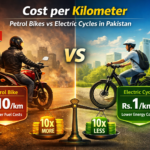
- Average fuel cost per kilometer: ~Rs. 8/km (varies with fuel prices)
- Daily commuting cost increases whenever fuel prices rise
- Monthly fuel expense becomes a fixed financial burden
Electric Cycle
- Average electricity cost per kilometer: ~Rs. 1/km
- Electricity prices are significantly more stable than petrol
- Daily commuting costs remain predictable
For someone commuting daily within the city, this difference adds up quickly over a month and a year.
Maintenance and Ownership Experience
Petrol Bike Maintenance
Petrol bikes require:
- Engine oil changes
- Regular servicing
- Spark plugs and filters
- Mechanical repairs over time
Maintenance costs increase as the bike ages.
Electric Cycle Maintenance
Electric cycles have:
- No engine oil
- No clutch or gearbox
- Fewer moving parts
As a result, maintenance is simpler, less frequent, and more affordable—especially for daily urban use.
Noise, Comfort, and City Riding
Petrol bikes:
- Produce engine noise and vibration
- Generate heat during long rides
- Are less comfortable in stop-and-go traffic
Electric cycles:
- Are quiet and smooth
- Perform well in traffic congestion
- Offer a more relaxed riding experience for short to medium distances
For city commuting, especially in congested areas, this difference is noticeable.
Environmental Impact: A Growing Concern
Petrol bikes contribute directly to:
- Urban air pollution
- Noise pollution
- Carbon emissions
Electric cycles produce no tailpipe emissions. While electricity generation may involve emissions, shifting daily commutes away from petrol significantly reduces pollution at street level—where people live and breathe.
For cities struggling with smog and poor air quality, electric two-wheelers offer a practical improvement.
Speed, Range, and Practical Use
It is important to be realistic.
Petrol Bikes Are Better If:
- You travel long distances daily
- You require high-speed highway riding
- You frequently carry heavy loads
Electric Cycles Are Better If:
- Your daily commute is within the city
- You travel moderate distances
- You want lower running costs and simpler ownership
Electric cycles are not designed to replace every petrol bike—but they are ideal for daily urban commuting.
Which One Makes Sense for You?
An electric cycle may be the better choice if you:
- Commute daily within the city
- Want to reduce monthly fuel expenses
- Prefer low maintenance
- Value quieter, cleaner transportation
A petrol bike may still make sense if:
- You regularly travel long distances
- You require higher speeds
- You frequently ride on highways
The right choice depends on how you actually use your vehicle—not habit or tradition.
Final Thoughts
In Pakistan’s current economic and environmental landscape, the electric cycle is no longer just an alternative—it is a practical solution for daily commuting.
For many students and office workers, switching from a petrol bike to an electric cycle can mean:
- Predictable monthly expenses
- Lower maintenance stress
- Cleaner urban living
In the next blog, we will address one of the most common concerns people have before switching: safety and reliability on Pakistani roads.